AML compliance for investment advisers has become a mandatory regulatory obligation following FinCEN’s AML Program Rule, which significantly amends the Bank Secrecy Act (BSA) by adding “investment adviser” to the definition of “financial institution”. This landmark rule subjects Registered Investment Advisers (RIAs) and Exempt Reporting Advisers (ERAs) to mandatory Anti-Money Laundering and Countering the Financing of Terrorism (AML/CFT) requirements—bringing investment advisers under the same BSA/AML regulatory framework that has long governed banks, broker-dealers, and other financial institutions.
While initially proposed for 2026, the compliance deadline has been extended to January 1, 2028, giving covered advisers a defined window to establish fully operational AML compliance programs aligned with FinCEN regulations, OFAC sanctions obligations, FATF Recommendations, and SEC examination expectations.
Whether you are searching for RIA Compliance Software, an AML platform for investment advisers, or a comprehensive BSA compliance solution for your advisory firm, KYCsphere’s AI-powered platform provides a unified AML Compliance Solution for Investment Advisers—bringing together its proven suite of KYC, screening, monitoring, and reporting tools to enable covered advisers to meet every obligation under the final rule.
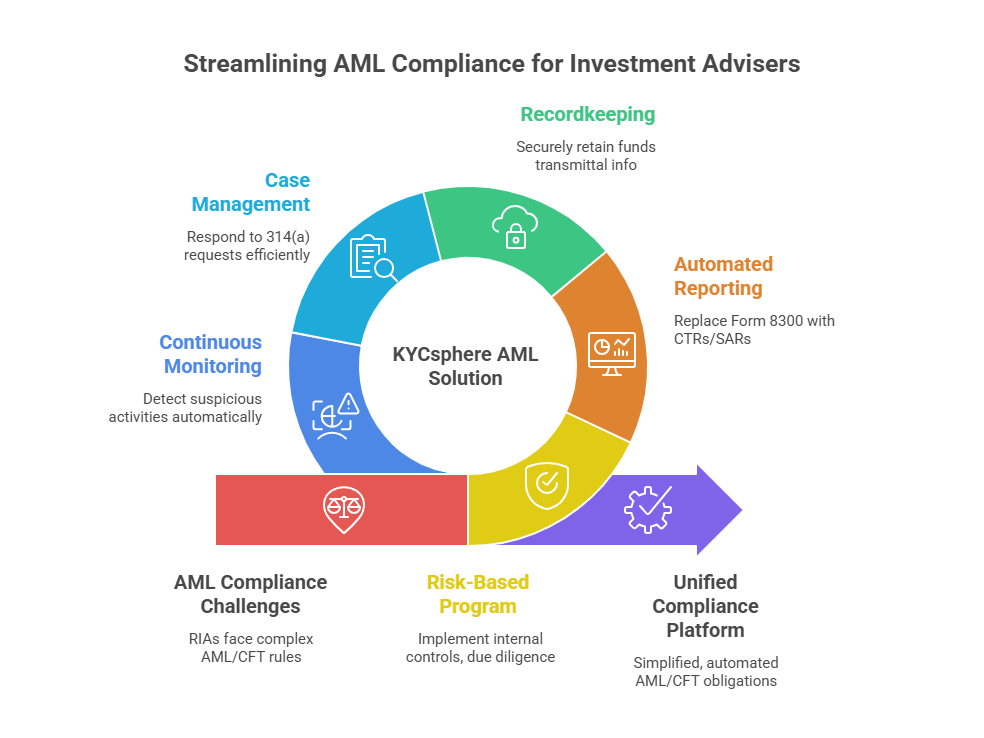
Why Investment Adviser AML Compliance is Complex: Regulatory & Operational Challenges
- Developing comprehensive AML/CFT programs from the ground up — Most investment advisers have never operated under BSA/AML obligations. Implementing the five mandatory pillars required by FinCEN’s AML Program Rule—internal policies and procedures, a designated BSA compliance officer, ongoing employee training, independent testing, and risk-based customer due diligence (CDD)—represents a fundamental operational transformation. This framework mirrors the program structure required under 31 CFR 1032 and aligns with the FATF risk-based approach to AML compliance.
- Transitioning from Form 8300 to mandatory BSA reporting — Moving from Form 8300 filing to the full BSA reporting regime—including filing Currency Transaction Reports (CTRs) for currency transactions exceeding $10,000 and filing Suspicious Activity Reports (SARs) through FinCEN’s BSA E-Filing System—requires new workflows, staff training, and automated reporting infrastructure. Failure to file timely and accurate SARs and CTRs can trigger severe FinCEN enforcement actions and civil money penalties.
- Meeting BSA recordkeeping and Funds Travel Rule requirements — Creating and retaining records for funds transmittals and ensuring originator and beneficiary information “travels” to the next financial institution in the payment chain, as mandated under the BSA Funds Travel Rule (31 CFR 1010.410), requires secure data capture and retention systems that meet FinCEN’s five-year recordkeeping standards and align with FATF Recommendation 16 on wire transfer transparency.
- Responding to FinCEN law enforcement requests — Establishing efficient processes to respond to Section 314(a) requests from FinCEN to locate accounts and transactions involving terrorism or money laundering investigations requires rapid search capabilities across all customer records. Additionally, participating in voluntary Section 314(b) information sharing with other financial institutions enhances your institution’s ability to detect cross-institutional suspicious activity patterns.
- Managing special due diligence for foreign financial institution accounts — Maintaining enhanced measures to detect and report suspicious activity involving correspondent accounts or private banking accounts for foreign financial institutions, as required under BSA Section 312 and reinforced by FATF Recommendations 13 and 14 on correspondent banking relationships, demands specialized screening and monitoring capabilities that most investment advisers currently lack.
- Preparing for SEC and FinCEN examination readiness — Your AML compliance solution should enable you to demonstrate a robust, well-documented AML/CFT program during examinations by FinCEN, SEC, OCIE (Office of Compliance Inspections and Examinations), or delegated SRO examiners—with complete audit trails, risk assessment documentation, and evidence of ongoing monitoring and reporting.
See how KYCsphere helps investment advisers build all five mandatory AML program pillars — from risk-based CDD and SAR filing to Funds Travel Rule recordkeeping and Section 314(a) response workflows — in one unified, examination-ready platform.
How KYCsphere’s Platform Delivers AML Compliance for Investment Advisers
FinCEN’s AML Program Rule fundamentally changes the compliance landscape for the investment advisory industry. Whether you are an RIA registered with the SEC, an ERA filing with the SEC, or an adviser managing private funds, your firm must now build and maintain an AML/CFT program that meets the same rigorous standards applied to banks and broker-dealers under the Bank Secrecy Act.
KYCsphere’s unified platform functions as your firm’s end-to-end AML compliance software—simplifying and automating these mandatory AML/CFT obligations for RIAs and ERAs:
- Risk-Based Program Implementation — Utilize KYCsphere’s Customer Risk Assessment and Customer Due Diligence (CDD) tools to establish internal controls and conduct ongoing customer due diligence as required by the final rule. The platform supports the risk-based approach mandated by FinCEN and recommended by FATF, including Enhanced Due Diligence (EDD) for higher-risk customers, Politically Exposed Persons (PEPs), and clients connected to FATF high-risk jurisdictions.
- Automated SAR & CTR Filing — KYCsphere’s Regulatory Reporting tool automates the replacement of Form 8300 with electronic CTR and SAR filings through FinCEN’s BSA E-Filing System for suspicious or high-value currency transactions. Built-in validation rules ensure filings meet FinCEN’s data quality standards, reducing rejection rates and demonstrating reporting program effectiveness during examinations.
- Recordkeeping & Funds Travel Rule Compliance — Securely capture and retain required funds transmittal information within KYCsphere’s dedicated cloud repository, ensuring your firm meets all BSA recordkeeping standards under 31 CFR 1010.410 and FATF Recommendation 16 on wire transfer transparency. All records are maintained for the FinCEN-mandated five-year retention period with immutable audit trails.
- Integrated Case Management for 314 Requests — Efficiently respond to Section 314(a) law enforcement requests from FinCEN and manage voluntary Section 314(b) information sharing through KYCsphere’s AML Case Management tool. Automated search capabilities across your entire customer database ensure timely responses within the FinCEN-prescribed 14-day deadline, with full documentation of search results and actions taken.
- Continuous Monitoring & Screening — Detect suspicious activities in correspondent accounts and private banking accounts for foreign financial institutions with KYCsphere’s automated Sanctions Screening (including OFAC SDN List, UN Consolidated List, UK Sanctions List and EU Sanctions List), PEP and Adverse Media Screening, and Transaction Monitoring tools. This continuous monitoring capability aligns with BSA Section 312 special due diligence requirements and OFAC’s Framework for Compliance Commitments.
- OFAC Sanctions Compliance Integration — While the FinCEN AML Program Rule does not separately impose OFAC obligations, investment advisers have always been subject to OFAC sanctions compliance as U.S. persons. KYCsphere’s integrated OFAC screening capability ensures your firm screens all clients, counterparties, and transactions against current OFAC sanctions lists—a critical compliance layer often overlooked by advisers building AML programs for the first time.
See how KYCsphere brings together customer due diligence, automated SAR and CTR filing, OFAC screening, transaction monitoring, and case management — giving RIAs and ERAs a single platform to meet every obligation under FinCEN’s AML Program Rule.
What KYCsphere’s AML Compliance Solution Delivers for Investment Advisers
- Cost-effective SaaS model for advisory firms — Build an audit-ready AML compliance repository on the cloud with a pay-as-you-go model, eliminating licensing fees and upfront capital costs. KYCsphere makes enterprise-grade BSA/AML compliance software capabilities—previously accessible only to large banks and broker-dealers—available to RIAs and ERAs of all sizes, from independent advisory practices to multi-billion-dollar asset managers.
- Incremental implementation aligned with the 2028 deadline — Roll out KYCsphere’s compliance capabilities—from customer due diligence and sanctions screening to SAR/CTR reporting and case management—incrementally to align with the extended January 1, 2028 compliance deadline. This phased approach allows your firm to build AML program maturity progressively, consistent with FinCEN’s expectation of reasonably designed programs and FATF’s risk-based implementation guidance.
- Audit-ready transparency for regulatory examinations — Maintain immutable audit trails and data-rich customer profiles that consistently excel in audits by FinCEN, SEC, OCIE, and external auditors. Every risk assessment, screening result, SAR filing decision, CDD review, and case management action is fully documented and retrievable—demonstrating the compliance program effectiveness that BSA examiners evaluate during supervisory reviews.
- Unified platform for cross-functional collaboration — Facilitate seamless collaboration between BSA compliance officers, operational teams, and senior management on a single platform. This unified approach supports the FinCEN requirement for senior management oversight of the AML program and ensures the designated compliance officer has enterprise-wide visibility into all compliance activities, risk indicators, and reporting obligations.
- Proactive regulatory intelligence — Stay ahead of evolving FinCEN guidance, OFAC sanctions changes, SEC examination priorities, and FATF mutual evaluation findings relevant to the investment advisory sector through KYCsphere’s integrated compliance news monitoring—ensuring your AML program evolves with the regulatory landscape rather than falling behind.
Request a demo and see how KYCsphere helps your advisory firm build an audit-ready AML compliance program incrementally — with immutable audit trails, unified compliance workflows, and proactive regulatory intelligence to keep your program current ahead of the January 1, 2028 deadline.
Frequently Asked Questions
Does FinCEN’s AML Program Rule apply to investment advisers?
Yes. FinCEN’s AML Program Rule formally adds “investment adviser” to the definition of “financial institution” under the Bank Secrecy Act — subjecting both Registered Investment Advisers (RIAs) and Exempt Reporting Advisers (ERAs) to mandatory AML/CFT programme requirements for the first time. The compliance deadline is January 1, 2028, giving covered advisers a defined window to build fully operational programmes aligned with FinCEN regulations, OFAC sanctions obligations, FATF Recommendations, and SEC examination expectations. Advisers that have previously operated only under Form 8300 obligations must now transition to the full BSA reporting regime.
What are the five mandatory pillars of an investment adviser AML programme?
FinCEN’s AML Program Rule requires investment advisers to establish five programme pillars mirroring those required of banks and broker-dealers under 31 CFR 1032: a system of internal policies, procedures, and controls; a designated BSA compliance officer with programme oversight responsibility; an ongoing employee training programme; independent testing of the programme by internal audit or a qualified third party; and risk-based customer due diligence including beneficial ownership identification. Most investment advisers have never operated under BSA/AML obligations, meaning all five pillars must be built from the ground up — a fundamental operational transformation that requires dedicated compliance technology to implement effectively within the 2028 deadline.
What BSA reporting obligations do RIAs and ERAs have under the new rule?
Under the AML Program Rule, investment advisers must replace Form 8300 filings with the full BSA electronic reporting regime — filing Currency Transaction Reports (CTRs) for currency transactions exceeding $10,000 through FinCEN’s BSA E-Filing System, and filing Suspicious Activity Reports (SARs) for transactions suspected of involving money laundering, fraud, or terrorist financing within BSA deadlines: 30 days for known subjects, 60 days for unknown. Advisers must also comply with the BSA Funds Travel Rule (31 CFR 1010.410), ensuring originator and beneficiary information travels with funds transmittals to the next institution in the payment chain — requiring secure data capture and five-year retention systems aligned with FATF Recommendation 16.
How must investment advisers respond to FinCEN Section 314(a) requests?
Section 314(a) requires covered financial institutions — now including RIAs and ERAs under the AML Program Rule — to search their customer records upon receipt of a FinCEN law enforcement request and respond within 14 calendar days, identifying any accounts or transactions matching the subjects of terrorism or money laundering investigations. Failure to respond within the 14-day window is a BSA compliance violation. Advisers must also have the option to participate in voluntary Section 314(b) information sharing with other financial institutions to detect cross-institutional suspicious activity patterns. AML case management software with automated search capabilities across the full customer database is essential for meeting the 314(a) deadline consistently without manual record reconstruction.
What special due diligence requirements apply to investment advisers with foreign financial institution accounts?
BSA Section 312, reinforced by FATF Recommendations 13 and 14 on correspondent banking relationships, requires enhanced measures for correspondent accounts and private banking accounts maintained for foreign financial institutions — including detecting and reporting suspicious activity involving those accounts and applying enhanced due diligence for foreign banks from jurisdictions identified as high-risk by FATF. For investment advisers managing offshore fund relationships, foreign institutional clients, or cross-border mandates, this represents a significant new compliance layer requiring specialised screening and monitoring capabilities beyond standard domestic client onboarding workflows.
How should investment advisers approach OFAC compliance under the AML Program Rule?
While FinCEN’s AML Program Rule does not separately impose OFAC obligations, investment advisers have always been subject to OFAC sanctions compliance as US persons — regardless of whether they are covered by the BSA. OFAC’s Framework for Compliance Commitments applies to all US persons and entities transacting with or for clients, meaning advisers must screen all clients, counterparties, and transactions against current OFAC sanctions lists including SDN, the Consolidated Sanctions List, and relevant country-based programmes. Advisers building AML programmes for the first time frequently overlook OFAC as a separate compliance layer — integrating OFAC screening within the same AML platform used for BSA compliance is the most efficient approach to covering both obligations without a separate vendor.
How can investment advisers build an audit-ready AML programme before the January 1, 2028 deadline?
The most effective approach for advisers building from scratch is incremental implementation aligned to the 2028 deadline — starting with the highest-urgency pillars (customer due diligence and OFAC screening) and phasing in SAR/CTR reporting infrastructure, Funds Travel Rule recordkeeping, and independent testing as programme maturity develops. Regulators expect “reasonably designed” programmes proportionate to the adviser’s size, client base, and risk profile — not a perfect day-one build. Cloud-based, pay-as-you-go AML compliance software eliminates the capital expenditure and multi-year implementation timelines that make enterprise AML systems impractical for most advisory firms, allowing incremental deployment of each programme component on a timeline aligned with the FinCEN deadline.